

Marmotte Granfondo Alpes training with ChatGPT or Claude.
Crest the Galibier inside the cut-off with 62 km and Alpe d’Huez still to come. Athmex gives your AI coach your event, FTP and the hours you really have. Create your free profile and we’ll show you the options for bringing your recent rides into the same conversation.
You. Your fitness. Your activity data. Together in Claude and ChatGPT.
Can ChatGPT or Claude help you train for the Marmotte Granfondo Alpes?
Yes. ChatGPT or Claude can help you check whether your start wave leaves room at the Galibier cut-off, shape a build towards a 177 km day in late June, and pace the Glandon, Télégraphe and Galibier so the Alpe is still rideable. It needs your FTP and when you tested it, your weight, your lowest gear, your biggest recent climbing days and the hours you can train.
Athmex keeps those in one athlete profile that ChatGPT or Claude can use in every conversation. The assistant gives the advice; Athmex keeps the context current.
- Event
- Marmotte Granfondo Alpes
- 2027 date
- Sunday 27 June 2027
- Start
- Bourg d’Oisans, in three waves: 6.30am, 6.50am and 7.10am
- Finish
- The top of Alpe d’Huez, after its 21 bends
- Route
- 177 km with 5,000 m of climbing over four cols
- Cols
- Glandon, Télégraphe, Galibier and Alpe d’Huez
- Cut-offs
- Galibier summit by 3.30pm; Bourg d’Oisans, at the foot of Alpe d’Huez, by 5.45pm
- Roads
- Open to traffic, with lights required in the tunnels
- Age (2026 rules)
- 18 and over in the calendar year, with parental authorisation for anyone still 17 on the day
Route, feeds, cut-offs and start waves are from the organiser’s Granfondo page, which carries the 2027 date. Age, bike and entry rules are from the organiser’s rules for the 2026 edition, the latest it has published.
Your recent rides belong in the conversation too
A Marmotte build runs from winter into June, and most of it happens a long way from any 2,000 m climb. The useful questions come from how your longest days compare with one that still has the Alpe to ride after the Galibier.
When your rides reach ChatGPT or Claude through your training platform’s own connection, your coach can see how the long days and the climbing are building, and what your power looked like on them. Routes differ by platform and by assistant.
Athmex doesn’t import activity. It keeps the context those rides are read against: your event, route, FTP, weight, weekly hours and constraints. Build your free athlete profile and Athmex will show you the best available way to bring your rides into ChatGPT or Claude for your setup.
From Athmex
Your event, route choice, FTP and when you tested it, weight, weekly hours, injuries and constraints.
From your training platform
The rides you’ve done, from Garmin, Wahoo, Strava and others, where a route exists for your setup.
In ChatGPT or Claude
One coaching conversation that can use both when you ask about your Marmotte build.
Four cols in order, and where the 5,000 m falls
The Marmotte leaves Bourg d’Oisans, rides about 10 km of flat road, then climbs the Col du Glandon. The organiser calls it a long and uneven first ascent. The descent from the Glandon is neutralised, and the timing is frozen on it, so nothing is won by taking risks there.
| Order | Col | What the organiser gives | Where it falls |
|---|---|---|---|
| 1 | Col du Glandon | A long and uneven first climb | After about 10 km of flat; summit feed at 36 km |
| 2 | Col du Télégraphe | 1,570 m | Out of the Maurienne valley; water at the col, 92 km |
| 3 | Col du Galibier | 2,645 m | Summit feed at 115 km, with a 3.30pm cut-off |
| 4 | Alpe d’Huez | 21 bends; the first two average 13% | From Bourg d’Oisans at 162 km to the finish at 177 km |
The climbing comes in three blocks. The Glandon opens the day. The Télégraphe and Galibier together climb about 2,000 m in 35 km, two-fifths of the day’s total, with Valloire at 98 km, the halfway point, between them. Then the route drops over the Col du Lautaret to Bourg d’Oisans, and the Alpe takes the last 15 km.
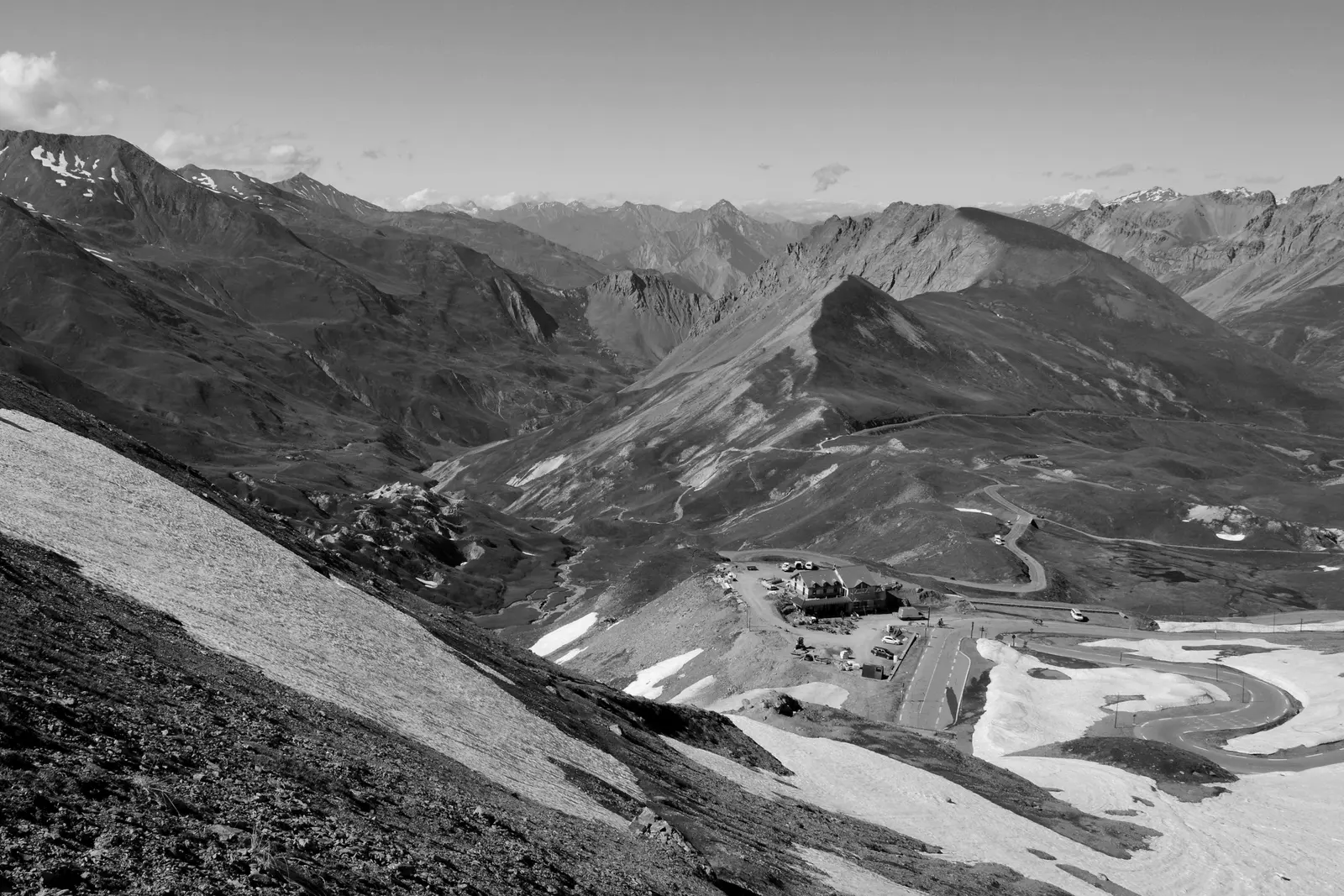
Cresting the Galibier with Alpe d’Huez still ahead
The Galibier is the top of the day, not the end of it. At its summit you have ridden 115 km, and 62 km remain, including the climb that decides your finish time. Riders who treat the Galibier as the finish line usually meet the Alpe with nothing left.
Physics gives a sense of scale. A rider and bike weighing about 80 kg, holding 200 W, gain something like 800 to 900 m an hour on a steady climb. For that rider, the Télégraphe and Galibier alone are well over two hours of climbing, and the Alpe opens with two bends that average 13%.
A common approach is to ride the Glandon and the Galibier well below threshold and keep your best effort for the Alpe. Ask ChatGPT or Claude to set a power range for each col from your FTP and weight, and to tell you what cadence your lowest gear gives on 13% with the power you’ll have left after 160 km. Those numbers only hold if the FTP is current, so keep a dated FTP in Athmex.
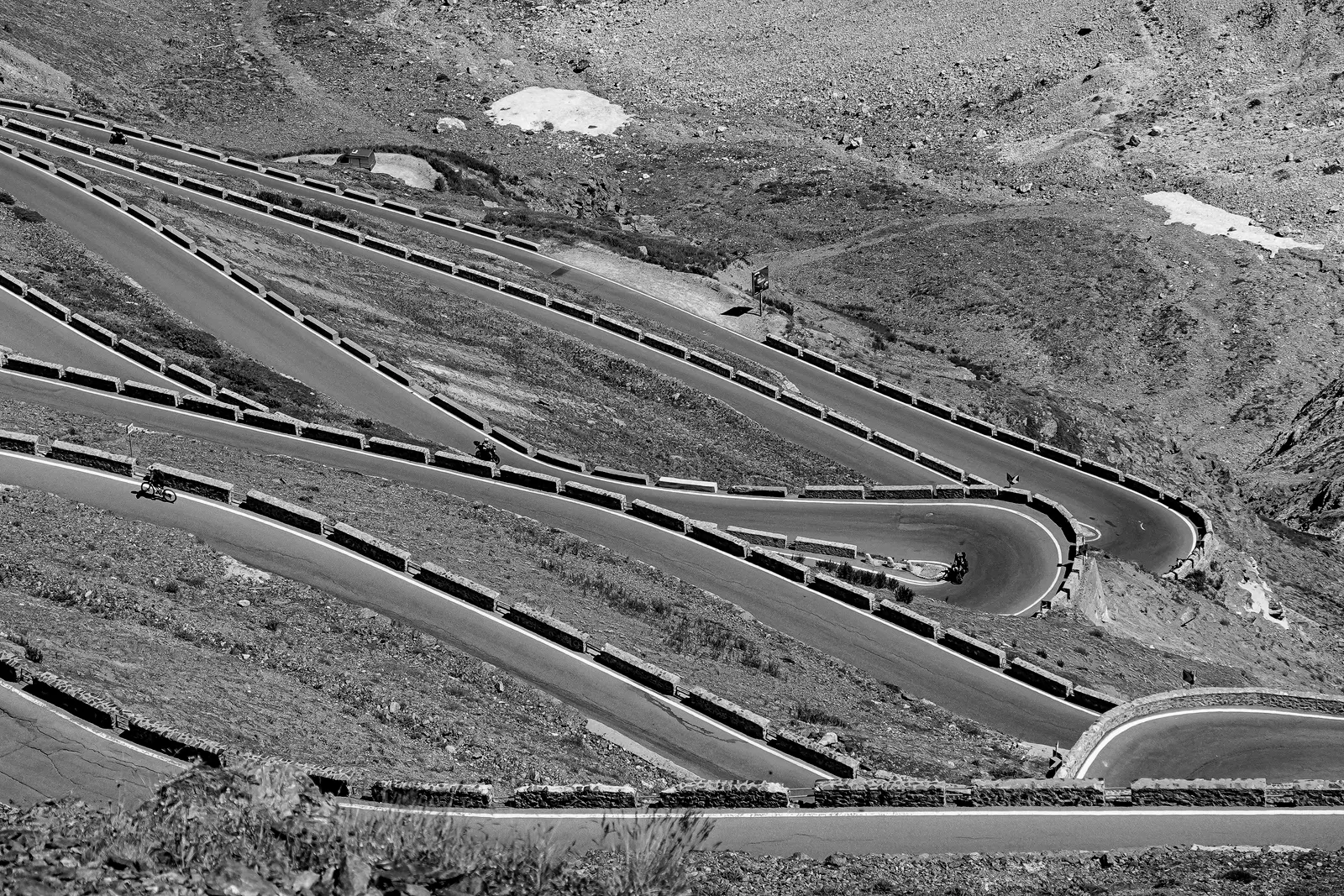
The Galibier and Bourg d’Oisans cut-offs, wave by wave
Both cut-offs are clock times. Riders must be over the Galibier summit by 3.30pm and at Bourg d’Oisans, at the foot of Alpe d’Huez, by 5.45pm, or they are taken out of the ride. The waves start 20 minutes apart, so the red wave has 40 minutes less than the first for the same roads. The minutes spent on the neutralised descent still count.
| Wave | Start | Galibier summit, 115 km, by 3.30pm | Bourg d’Oisans, 162 km, by 5.45pm |
|---|---|---|---|
| Green and yellow numbers | 6.30am | 9 hours; about 12.8 km/h | 11 hours 15 minutes; about 14.4 km/h |
| Blue numbers | 6.50am | 8 hours 40 minutes; about 13.3 km/h | 10 hours 55 minutes; about 14.8 km/h |
| Red numbers | 7.10am | 8 hours 20 minutes; about 13.8 km/h | 10 hours 35 minutes; about 15.3 km/h |
A rider who reaches the Galibier right on 3.30pm has 2 hours 15 minutes for the 47 km down to Bourg d’Oisans, about 21 km/h, on open roads and through tunnels.
Pens are allocated from previous results, and first-timers are placed by their estimated time. Ask ChatGPT or Claude to estimate your time to the Galibier from your FTP, weight and a recent climbing day, and use it to check how much room your wave leaves.
Feeds, water points and the 47 km with none
The organiser lists four feed stations and five extra water points. Feeds carry water, sports drink, cola, bars and gels, bananas and other fruit, and sweet and salted snacks.
| Kilometre | Place | What’s there |
|---|---|---|
| 36 | Col du Glandon summit | Feed station |
| 79 | Saint-Michel-de-Maurienne | Water point |
| 92 | Col du Télégraphe | Water point |
| 98 | Valloire, halfway | Feed station |
| 107 | Plan Lachat, on the Galibier | Water point |
| 115 | Col du Galibier summit | Feed station |
| 162 | Bourg d’Oisans, at the foot of the Alpe | Feed station |
| 165 | La Garde | Water point |
| 170 | Huez | Water point |
The longest gap is the one after the Galibier summit: 47 km to Bourg d’Oisans with nothing listed. It is mostly downhill, which makes it the easiest place to forget to eat. Leave the summit with full bottles, eat on the way down, and refill at Bourg d’Oisans before the first bends.
For long days, a common aim is somewhere around 60 to 90 grams of carbohydrate an hour, for riders whose gut has been trained to take it. Ask ChatGPT or Claude to turn what you actually eat on long rides into an amount for each gap in this table, then keep it in the event’s notes in Athmex.
A Marmotte training plan by month, from entry to late June
The Marmotte asks for hours of steady climbing, then more of it after lunch. A late-June date gives a long build, but the early months are usually indoors or on lower roads.
| Month | What the training is for |
|---|---|
| November and December | Entry, steady aerobic riding and strength work off the bike. |
| January | Long seated efforts at a steady power, building from 20 minutes towards an hour. |
| February | Rides towards four hours, eating and drinking to a schedule on every one. |
| March | Two-hour blocks of climbing, real or indoor, and an FTP retest to check your estimated time. |
| April | Back-to-back long days, the second ending on a long climb, and descending practice. |
| May | The biggest weeks: a day of six hours or more with all the climbing your roads allow, on race gearing, lights and food. |
| June | A short taper, travel to the Oisans and the day’s plan settled. |
If your nearest climb takes ten minutes, the trainer stands in for the Galibier. Indoor cycling with ChatGPT or Claude covers sustained work indoors. Tell ChatGPT or Claude your real week and your terrain, and it can fit these months around them.
Entry, the medical certificate and the rules that catch riders out
Entry is through the organiser, and the price rises in steps as places sell. Its pricing page, which names no edition, lists the Granfondo at €110 for the first 500 entries, €120 for the next 1,000, €125 for the next 2,000 and €130 after that. Check the organiser’s site for when 2027 entries open. Under the organiser’s 2026 rules, entries are personal and can’t be transferred, resold or refunded. Athmex doesn’t sell or manage entries.
The organiser’s Q&A says you need a medical certificate or a competitive cycling licence, and the 2026 rules specify a certificate for competitive cycling, dated less than a year before the event and uploaded to your entry account. Under those rules, riders without one are moved to the Randonnée, which has no ranking.
Under the 2026 rules the roads stay open to traffic, so the highway code applies all day and following cars aren’t allowed. The organiser’s Q&A says front and rear lights are mandatory because the tunnels have little or no lighting, that a visibility waistcoat must be worn, and that missing lights mean immediate exclusion. The 2026 rules also make a hard-shell helmet compulsory throughout, ban triathlon bars and accept e-bikes only on the Randonnée. Changing route during the ride also moves you to the Randonnée.
Numbers are collected in person at the Palais des Sports in Alpe d’Huez, with ID and your e-ticket, from Thursday 24 to Saturday 26 June. The start is in Bourg d’Oisans and the finish at the top of the Alpe, so plan the morning journey down and the return from the finish when you book a bed.
Marmotte or Étape: how the two Alpine days differ
Both are long Alpine days a fortnight apart, and many riders weigh one against the other. They ask for different things.
| Marmotte Granfondo Alpes | L’Étape du Tour | |
|---|---|---|
| 2027 date | Sunday 27 June | Sunday 11 July |
| Distance | 177 km | 154 km |
| Climbing | 5,000 m | 4,850 m |
| Climbing per kilometre | About 28 m | About 31 m |
| Start and finish | Bourg d’Oisans to the top of Alpe d’Huez | Cluses to Les Saisies |
| Last climb | Alpe d’Huez, 21 bends | Bisanne, 12.4 km at 8.3% |
The Marmotte is the longer day, with fewer, bigger cols and the hardest one last. L’Étape du Tour training with ChatGPT or Claude covers the 2027 Étape from Cluses.
What to bring to your Marmotte training conversation
Put your Marmotte date, current fitness, gearing and training week in one place before you ask for a plan.
- Event
- Marmotte Granfondo Alpes, Sunday 27 June 2027, and your start wave if you know it.
- FTP
- Your current FTP and the date you tested it.
- Weight
- Your weight and roughly what the bike weighs, for climbing speed on the Galibier.
- Gearing
- Your chainset and cassette, above all your lowest gear for 13% on the Alpe.
- Climbing days
- Your biggest recent days, with distance, climbing and time.
- Weekly hours
- What you can really ride each week, indoors and out.
- Terrain
- How long your nearest climbs are, or whether you train mostly indoors.
- Fuelling
- What you eat on long rides, and what you stop wanting after eight hours.
- Constraints
- Injuries, work, family and the trip to the Alps.
Marmotte rider training example
A fictional rider, to show what a useful answer is built from: a dated FTP, real climbing days, gearing and hours.
The questionI’m in the red wave. Can I make the Galibier by 3.30pm and still ride the Alpe?
A useful answer starts from 255 W at 77 kg and a 34 by 32 lowest gear. It estimates the time to the Galibier from 7.10am against the 3.30pm cut-off, sets a power range for each col that leaves something for the Alpe, works out the cadence that gear gives on 13%, and notes that the biggest day so far, 3,100 m, is well short of 5,000 m, so May needs a bigger one.
Climbing training with ChatGPT or Claude covers the long, steady efforts this build relies on.
Example athlete profile
- Goal
- Finish on the Alpe inside the cut-offsFirst Marmotte
- Event
- Marmotte Granfondo Alpes · Sunday 27 JuneRed wave, 7.10am
- FTP
- 255 W · 3.3 W/kgTested in December
- Biggest day
- 150 km, 3,100 mLast September
- Lowest gear
- 34 by 32Compact chainset
- Weekly hours
- 8 to 10Two indoor evenings
- Constraints
- Neck stiff after six hoursBike fit booked for February
- Max heart rate
- Not knownLeft blank until it’s measured
Questions to bring back during the build
A Marmotte build runs from entry in the winter to the last Sunday in June. These are the moments to come back, with the question you might ask.
When your entry is confirmed
I’ve entered the Marmotte Granfondo Alpes on 27 June. Save it as my main event and tell me what the winter is for.
A dated target lets every later answer count back from the day. Long-distance cycling with ChatGPT or Claude covers the base work.
After an FTP retest
I tested at 266 W today. Save it, then tell me how much room the red wave now leaves at the Galibier.
A new FTP moves every estimate on this page. Save it with its date in Athmex. Raising FTP with ChatGPT or Claude explains how to test well.
After your biggest climbing day
I rode 165 km with 3,800 m in nine hours and faded badly on the last climb. What should May look like?
A real climbing day is the best evidence for your pacing on the Galibier. Save it, and note where the fade started.
In race week
I arrive at Alpe d’Huez on Thursday. Plan my last days, what I carry from the Galibier to Bourg d’Oisans and my effort on the Glandon.
Race week is about arriving rested, with the number collected, the lights fitted and the long descent fed. What to tell ChatGPT or Claude before the day sets out what to share before the ride.
Getting your Marmotte context ready
- 01
Build your athlete profile
Add the Marmotte Granfondo Alpes, 27 June 2027 and your start wave if you know it, then your FTP with its test date, weight, lowest gear, biggest climbing days and weekly hours. Leave what you don’t know blank.
- 02
Connect ChatGPT or Claude
We walk you through it inside Athmex, step by step. No coding.
- 03
Bring your recent rides in too
We’ll show you the available options for bringing your rides from Garmin, Wahoo, Strava and other platforms into ChatGPT or Claude.
Where AI help stops
ChatGPT or Claude can misjudge a goal, plan more climbing than your body can absorb or rescale a whole block from a stale FTP, so read its plan critically and check it against how you feel.
Descending, bunch riding and mountain weather are skills and judgements no chat can practise for you. Pain, illness, fainting or anything medical needs a doctor. No AI can examine you.
Marmotte Granfondo Alpes questions
Can ChatGPT make a Marmotte training plan?
Yes. ChatGPT or Claude can draft and adapt a Marmotte plan. It’s more useful when it knows your start wave, FTP with its test date, weight, lowest gear, biggest climbing days and weekly hours. Athmex keeps those ready.
When is the Marmotte Granfondo Alpes in 2027?
Sunday 27 June 2027, from Bourg d’Oisans to the top of Alpe d’Huez. The first wave starts at 6.30am, the second at 6.50am and the third at 7.10am.
How long and how hilly is the Marmotte?
The organiser gives 177 km with 5,000 m of climbing over four cols: the Glandon, Télégraphe, Galibier and Alpe d’Huez. The Télégraphe and Galibier together climb about 2,000 m, and the Galibier summit, at 2,645 m, comes at 115 km.
What are the Marmotte cut-off times?
Riders must be over the Galibier summit by 3.30pm and at Bourg d’Oisans, at the foot of Alpe d’Huez, by 5.45pm. Both are clock times, so the 7.10am wave has 40 minutes less than the 6.30am wave.
Do you need a medical certificate for the Marmotte?
Yes, unless you hold a competitive cycling licence. Under the organiser’s 2026 rules the certificate must be for competitive cycling and dated less than a year before the event, and riders without one are moved to the Randonnée, which has no ranking.
What lights and bikes are allowed on the Marmotte?
The roads are open to traffic and the tunnels have little or no lighting, so the organiser’s Q&A makes front and rear lights mandatory, requires a visibility waistcoat and excludes riders without lights. Under its 2026 rules a hard-shell helmet is compulsory, triathlon bars are banned and e-bikes are accepted only on the Randonnée.
What does Athmex add to ChatGPT or Claude?
Athmex keeps your athlete context ready for your Marmotte build: event, route, FTP, weight, weekly hours, injuries and constraints. ChatGPT or Claude does the coaching. Athmex doesn’t import activity, but it shows you the best available way to bring your recent rides into ChatGPT or Claude for your setup.
Keep your Marmotte build ready for ChatGPT or Claude.
Build your athlete profile once. Connect ChatGPT or Claude. Keep your event, FTP, weekly hours and constraints current from the first long ride to the start line.
You. Your fitness. Your activity data. Together in Claude and ChatGPT.