

Tokyo Marathon training with ChatGPT or Claude.
Plan a winter build for Tokyo and a race on the other side of the world. Athmex gives your AI coach your race day, recent times, travel plans and the week you really have. We’ll also help you connect your training platforms, so it can use your recent runs too.
14 days free · then $6.99/month · cancel anytime
Can ChatGPT or Claude help you train for the Tokyo Marathon?
Yes. ChatGPT or Claude can help you plan a Tokyo build through the winter, rework weeks lost to holidays or bad weather, and shape your last ten days around a long flight. Its advice gets specific once it knows your race day, recent times and the trip.
Athmex keeps those facts in one athlete profile that ChatGPT or Claude can use in every conversation. The assistant gives the advice; Athmex keeps the context current.
- Event
- Tokyo Marathon
- Where
- Tokyo, Japan. Starts at the Tokyo Metropolitan Government Building and finishes by Tokyo Station.
- Distance
- 42.2 km (26.2 miles)
- 2027 race day
- Sunday 7 March 2027
- Time limit
- 7 hours from the start gun, with cut-off points along the course
The organiser’s plans for the 2027 race. Your entry confirms your start and cut-off details. Athmex has no connection with the Tokyo Marathon or its organiser.
Your recent runs belong in the conversation too
A build that runs through December, January and February rarely goes to plan. The useful questions come from the weeks that didn’t.
When your recent runs reach ChatGPT or Claude through your training platform’s own connection, your coach can check how the long runs are building and whether last week went as planned. Routes differ by platform and by assistant.
Athmex doesn’t import activity. It keeps the context those runs are read against: your race day, goal, recent times and training week. Start your free trial and Athmex will show you the best available way to bring your runs into ChatGPT or Claude for your setup.
From Athmex
Your race day, goal, PBs, threshold, training days, injuries and constraints.
From your training platform
The runs you’ve done, from Garmin, COROS, Strava and others, where a route exists for your setup.
In ChatGPT or Claude
One coaching conversation that can use both when you ask about your Tokyo build.
An early-March race means a winter build
Count back from 7 March and, for runners in Europe or North America, the longest runs land in January and February. That means dark mornings, cold and icy days, and a build that runs straight through Christmas and New Year.
None of that is a reason to change the race, but it should change the plan. Tell ChatGPT or Claude which weeks you’ll be away or busy before it writes anything, so the hardest weeks are placed around the holidays rather than through them.
A long flight sits in your taper
For most runners from outside Japan, Tokyo means a long-haul flight and several hours of time difference in the last week. The taper, the last easy runs and your sleep all have to fit around it.
Give the assistant your flight day, arrival day and the time difference from home, then ask it to plan the final ten days around them. Store the trip in your race notes in Athmex, and it doesn’t need explaining again in race week.
The clock starts with the gun
Tokyo’s seven-hour limit is measured from the start gun, and there are cut-off points along the course where runners behind schedule are stopped. If you start near the back, part of your seven hours has gone before you cross the line.
For a runner aiming to finish, that makes an honest finish estimate more useful than a hopeful one. Tell the assistant your realistic range and where you expect to start, and ask it to check your pacing against the cut-off times in your entry information.
What to bring to your Tokyo training conversation
The facts that turn a generic marathon plan into a Tokyo plan. Save them once in Athmex rather than retyping them.
- Race day
- Sunday 7 March 2027.
- Goal
- Finish and enjoy it, a round-number time or a specific target.
- Recent races
- Half-marathon, 10K or previous marathon times, each with its date.
- Current running
- How many days a week you run now and how long you’ve been consistent.
- Travel
- Flight dates, arrival day and the time difference from home.
- Winter weeks
- Holidays, travel and weeks when dark or icy mornings will cut your running.
- Constraints
- Injuries and niggles, work, family and anything else the build has to fit around.
One Tokyo runner, one useful question
An illustrative runner, not a real athlete or customer. This is the profile ChatGPT or Claude could work from before the runner types a word.
The questionHow should my last ten days work around an overnight flight that lands on the Thursday before the race?
A useful answer moves the last longer run earlier, keeps the runs either side of the flight short and easy, and plans a gentle shake-out in Tokyo. Because Japan is nine hours ahead of the UK in early March, it treats sleep in the first nights as part of the taper.
What to tell ChatGPT or Claude before race day covers the rest of race week.
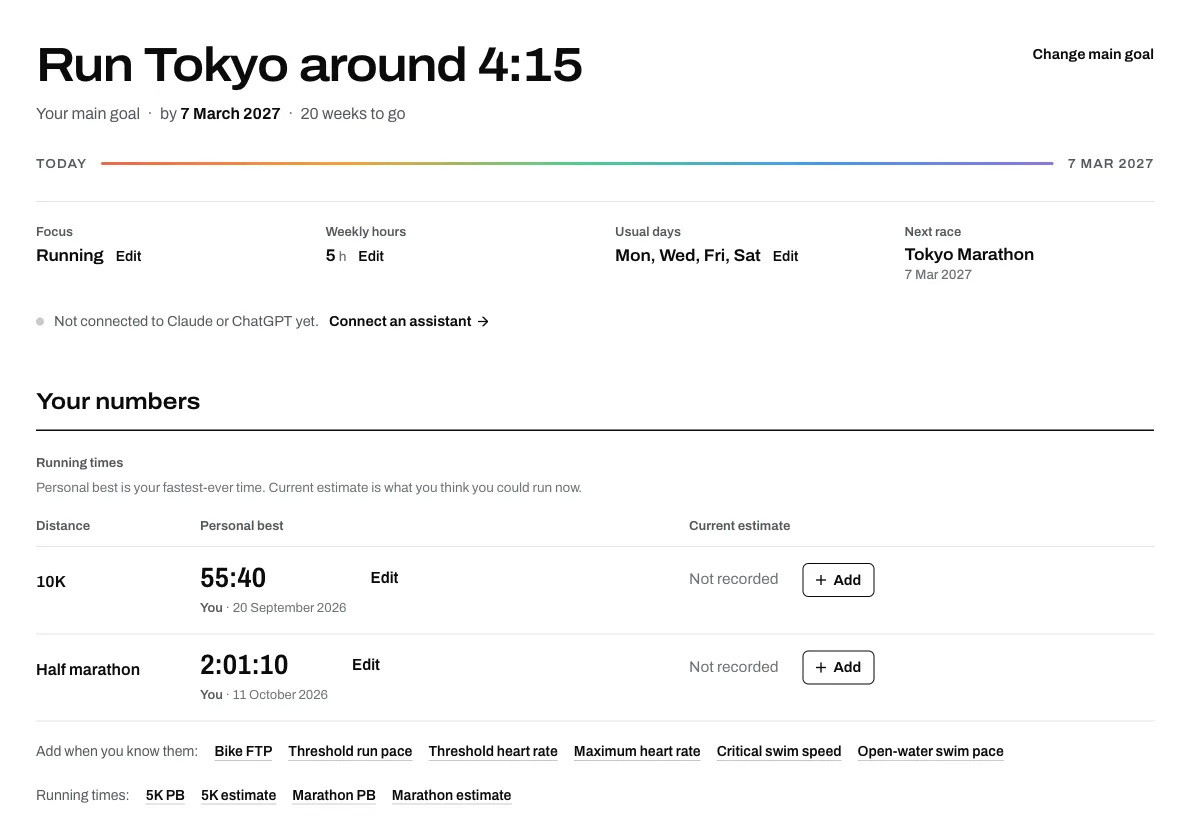
Example athlete profile
- Goal
- Around 4:15First marathon abroad
- Race
- Tokyo Marathon · Sunday 7 MarchMain race of the year
- PBs
- Half 2:01:10 · 10K 55:40Half set in October
- Threshold
- Not knownLeft blank until it’s measured
- Training days
- Four days a weekLong run Saturday
- Travel
- Flies out WednesdayLands Thursday, nine hours ahead of home
- Injuries
- NoneNothing to train around
Questions to bring back during the build
A Tokyo build runs through the darkest months of the year. These are the moments to come back, with the question you might ask.
When the holidays take a week
I’m with family from 23 December to 2 January. How do I keep the build going?
A week of reduced running in the middle of a winter build is normal. Ask for a sensible rework, then keep your training days in Athmex current if anything changes for longer. Why an AI plan ignores your schedule explains what goes wrong when it doesn’t know.
After a winter half
I ran 1:58:20 at a half on Sunday. Update my half-marathon PB, then tell me what it means for Tokyo.
A January or February half marathon is the clearest check on how the winter has gone. Save the new time with its date and the next conversation starts from it. What to update after a race covers the rest.
When the weather wins
It’s icy all week. Should I run my long run on a treadmill or move it to next weekend?
There’s no single right answer, which is why the conversation helps. The assistant can weigh where you are in the build against what moving the run would cost.
In race week
I land in Tokyo on Thursday morning. Plan my runs, sleep and meals until Sunday.
By race week the work is done. What’s left is arriving rested, with your pacing and race-morning plan settled.
Getting your Tokyo context ready
- 01
Build your athlete profile
Add Tokyo, its date and your goal, recent times, training days and your travel plans. Leave what you don’t know blank.
- 02
Connect ChatGPT or Claude
We walk you through it inside Athmex, step by step. No coding.
- 03
Bring your recent runs in too
We’ll show you how to bring available activity data from Garmin, COROS, Strava and other platforms into ChatGPT or Claude.
Where AI help stops
A marathon build is long enough for small misunderstandings to add up. ChatGPT or Claude can misjudge a goal, pacing you off the target rather than your fitness, or suggest more than your body can take, so read its plan critically and check it against how you feel.
Pain that changes how you run, illness, fainting or anything medical needs a doctor or physio. No AI can examine you.
Tokyo Marathon questions
Can ChatGPT make a Tokyo Marathon training plan?
Yes. ChatGPT or Claude can draft and adapt a Tokyo plan. It’s more useful when it knows your race day, goal, recent race times with dates, current running, travel and the weeks the winter will cost you. Athmex keeps those ready, so you don’t retype them in every conversation.
When is the 2027 Tokyo Marathon?
Sunday 7 March 2027. It starts at the Tokyo Metropolitan Government Building and finishes by Tokyo Station. Your entry confirms your own start details.
What is the Tokyo Marathon time limit?
Seven hours, measured from the start gun, with cut-off points along the course where runners behind schedule are stopped. Your entry information gives the cut-off times.
What should I tell Claude about my trip to Tokyo?
Your flight day, arrival day, the time difference from home and any plans for the days before the race. With those, it can shape the last ten days of your build around the journey.
What does Athmex add to ChatGPT or Claude?
Athmex keeps your athlete context ready for your Tokyo build: race day, goal, PBs, threshold, training days, injuries and constraints. ChatGPT or Claude does the coaching. Athmex doesn’t import activity, but it shows you the best available way to bring your recent runs into ChatGPT or Claude for your setup.
Keep your Tokyo build ready for ChatGPT or Claude.
Build your athlete profile once. Connect ChatGPT or Claude. Keep your race day, times, training days and constraints current from the first long run to race week.
14 days free · then $6.99/month · cancel anytime